
Shem as Melchizedek
Was Shem operating as the High Priest of Jerusalem under a new name?

In the last section, we mentioned the Targum Yonasan as the earliest source for the tradition that Shem was the same figure as Melchizedek. While it is true that this is the earliest extant tradition of this connection, the source is not the “reason” for this connection, but is rather a Talmudic sage merely expounding on what was known about the Torah. Why? Why was Shem the same as Melchizedek and can we find a deeper source relating these two? From the Kitzur Baal haTurim ““מלך שלם” (”King of Salem”) The initial letters of these words spell the name Shem. This teaches that Malchizedek was Shem, the son of Noah”1 The letters ‘Mem’ and ‘Shin’ at the start of the worlds Melech and Salem when reversed spell the name “Shem”, hinting at the hidden reality of the King of Salem being the same as Shem.
Relating to his role as intergenerational priest-astronomer, the question would become “what was Shem doing during the life of Abraham?” It was obviously near impossible for these towering spiritual giants to have avoided each other, which explains why Jewish sources are replete with interactions between the two patriarchs. However, what were the details of this interaction, and what exactly was the mechanism by which Shem ‘passed over’ the Torah to Abraham?
Commenting on Genesis 14:18, from the Talmud we learn: “Rabbi Zekharya said in the name of Rabbi Yishmael: The Holy One, Blessed be He, wanted the priesthood to emerge from Shem, as it is stated: “and he was priest of God the Most High” Once Melchizedek, placed the blessing of Abraham before the blessing of the Omnipresent, He had the priesthood emerge from Abraham in particular, and not from any other descendant of Shem.”2 We are specifically told why Shem loses the priesthood to Abraham, due to his failure to ‘place the Omnipresent’s name first during his blessing’.
The Talmud continues the narrative, explaining what it means by the failure in the following line: “As it is stated: “And he blessed him and said: Blessed be Abram of God Most High, Maker of heaven and earth, and blessed be God the Most High” (Genesis 14:19–20). Abraham said to him: And does one place the blessing of the servant before the blessing of his master? You should have blessed God first. Immediately the Holy One, Blessed be He, gave the priesthood to Abraham, as it is stated in Psalms 110:1: “The Lord says to my lord: Sit at My right hand, until I make your enemies your footstool”, and afterward it is written: “The Lord has sworn, and will not repent: you shall be a priest forever, because you are a king of righteousness [al divrati malki tzedek]” (Psalms 110:4), which is explained homiletically to mean: Due to the improper words [divrati] of Melchizedek, the offspring of Abraham shall be priests of God forever.”3
Immediately following we are provided with textual evidence why it is only Melchizedek, and not his children, who will be priests “And this is as it is written: “And he was priest of God the Most High” (Genesis 14:18), which emphasizes that he, Melchizedek, is a priest, but his children will not be priests.”4 This bares out an interesting question within the answer, who are these children of Melchizedek? Obviously, if Shem was Melchizedek, then the literal answer here is the other children of Shem: Elam, Ashur, Arpachshad, Lud and Aram. This also creates a few difficult to solve problems, such as Eber, the grandson of Arpachshad, and his role in matters. Perhaps Eber was temporarily given this priesthood, before passing it to his own descendant, Abraham. This would make the answer simple. Alternatively, Eber could really have just been the Av Beit Din - essentially, the second in command - of the combined court-yeshiva. Whatever the case, it was through them that Abraham was passed the title of High Priest, and from there that the children of Abraham likewise retained this title in the later generations.
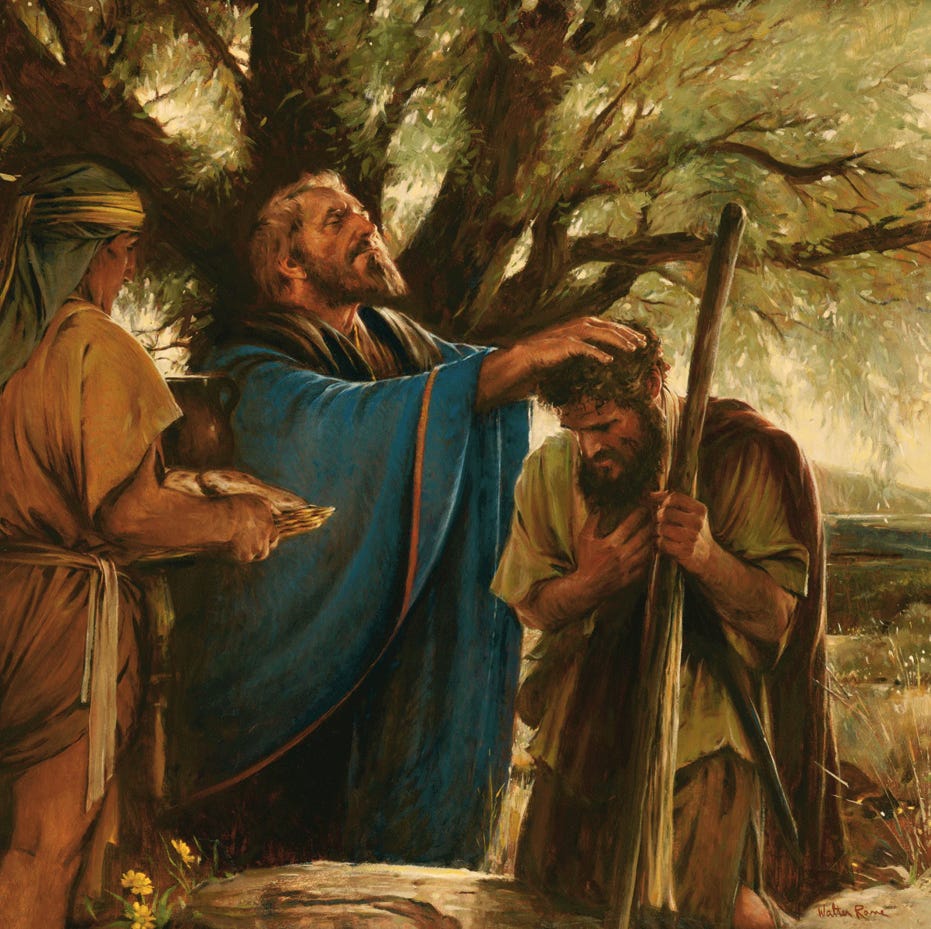
However, one curious descendent of Melchizedek may have deep significance to certain events in the Torah. From Bereshit Rabbah, through a curious student of Rabbi Meir we are told about a daughter of Shem “Efrayim the cucumber seller [makshaa], student of Rabbi Meir, said in the name of Rabbi Meir: Tamar was the daughter of Shem, as it is written: “The daughter of a man who is a priest, [if she shall profane herself by acting as a harlot…she shall be burned in fire]” (Leviticus 21:9); that is why [Judah said]: “Take her out, and she shall be burned.”5 The connection here is that in Leviticus, there is a law to burn the daughter of a priest who is acting in profane ways, thus, when Judah suggested to burn Tamar he was acting in accordance with this law.
Digging further into the Talmud, we find that the Gemara cites a somewhat similar statement. “Rabbi Elazar says: In three places the Divine Spirit appeared before all to affirm that the action taken was appropriate: In the court of Shem, in the court of Samuel the Ramathite, and in the court of Solomon. The Gemara elaborates: This occurred in the court of Shem, as it is written in the context of the episode of Judah and Tamar: “And Judah acknowledged them and said: She is more righteous than I [mimmenni]” (Genesis 38:26). How did Judah know that Tamar’s assertion that she was bearing his child was correct? Perhaps, just as he went to her and hired her as a prostitute, another person went to her and hired her as well, and he is not the father. Rather, a Divine Voice emerged and said: It is from Me [mimmenni] that these secrets emerged. God affirmed that her assertion was correct and that it was His divine plan that Judah would father a child from Tamar.”6 From Makkot we can confirm this strange side tangent from the Midrash regarding Tamar’s lofty heritage. This seemingly makes the Judahites, and thus nearly all Jews, direct descendants of Shem on the matrilineal side. This may, or may not, be a contributing factor for the divine character of the Judahite nation in contrast with the Israelite (Northern) nation, and why the temple was ultimately built inside Benjamin x Judah’s combined territory. Furthermore, this provides an even more direct mechanism of transition from Shem to Abraham, as his people literally marry into the lineage of Melchizedek.
Next we have a story from the Talmud, tractate Sanhedrin, that relates a conversation between Eliezer, servant of Abraham and Shem. Beginning the discussion, Shem first speaks to Eliezer asking a question about the war of the kings: “Rav Ḥana bar Leva’ei says that Shem the Great said to Eliezer, When the four great kings of the east and the west came upon you to wage war with Abraham, what did you do?” Next, we have Eliezer who “said to him: The Holy One, Blessed be He, brought Abraham and placed him to His right, and we would throw dust and it became swords, and we threw straw and it became arrows, as it is stated: “A Psalm of David. The Lord says to my master: Sit to My right, until I make your enemies your footstool” (Psalms 110:1), and it is written: “Who has raised up one from the east at whose steps victory attends? He gives nations before him, and makes him rule over kings; his sword makes them as the dust, his bow as driven straw” (Isaiah 41:2).”7 What is important here is not exactly the how part of what Eliezer and Abraham did during the war, but rather where the sages are seemingly citing the source for these events. The first comes from Psalms, and the second from Isaiah. While it is well known the prophets would see events disconnected from their temporal alignment (i.e., time is distorted during prophetic visions and prophets can often see every variant of the event in each cycle) and thus Isaiah seeing a vision related to the war of Abraham is not that odd. However, it is the Psalm source that becomes more interesting, as each Psalm is typically associated with a specific writer. The writer in question for this song is clearly implied to be Shem, acting as Melchizedek.
We turn again to a Talmudic source in Bava Basra that actually discusses the exact provenance of each book of the Tanach: “And who wrote the books of the Bible? Moses wrote his own book, i.e., the Torah, and the portion of Balaam in the Torah, and the book of Job. Joshua wrote his own book and eight verses in the Torah, which describe the death of Moses. Samuel wrote his own book, the book of Judges, and the book of Ruth. David wrote the book of Psalms by means of ten elders of previous generations, assembling a collection that included compositions of others along with his own. He included psalms authored by Adam the first man, by Melchizedek king of Salem, and by Abraham, and by Moses, and by Heman, and by Jeduthun, and by Asaph, and by the three sons of Korah.”8 This is obviously a very interesting source, and one might wish to know what Psalms the other figures have written, but for our purpose here it does completely confirm that Melchizedek was a writer of a Psalm. Connected to our previous Talmudic source, it becomes clear that Psalm 110 is the one purported to be authored by Shem. We actually have Rashi on Bava Batra 14b:12:6, where he directly confirms this is the correct psalm “by the hand of Malki-Ẓedek – “Said the LORD to my lord, [sit at my right hand]” and all that psalm (Psalm 110).”
Let’s look at the exact text of the so-called “Psalm of Melchizedek”: “Of David a psalm. The word of the Lord to my master; “Wait for My right hand, until I make your enemies a footstool at your feet.”The staff of your might the Lord will send from Zion; rule in the midst of your enemies.Your people will volunteer on the day of your host, because of the beauty of holiness when you fell from the womb; for you, your youth is like dew.The Lord swore and will not repent; you are a priest forever because of the speech of Malchizedek.The Lord, on your right hand, has crushed kings on the day of His wrath.He will execute justice upon the nations [into] a heap of corpses; He crushed the head on a great land.From the stream on the way he would drink; therefore, he raised his head.”9 Quite an odd one, given that it starts off saying it’s a Psalm of David, but that’s not particularly strange given the entire book was compiled in David’s court, under his watch. The strange part is this “speech of Melchizedek” which implies that Psalm itself was that very speech, given to Abraham by Melchizedek before the battle with the kings.
Kitzur Baal HaTurim on Genesis 14:18:1
Talmud Nedarim 32b:6
Talmud Nedarim 32b:7
Talmud Nedarim 32b:8
Bereshit Rabbah 85:10
Makkot 23b:12
Sanhedrin 108b:21
Bava Basra 14b:12
Psalm 110