

Shem the Ancient
The Immortal Lifespan of the Last Antediluvian

Shem’s role as the transfer point for intergenerational wisdom aligns with the biblical length of his age. Notably, Shem only dies when Abraham is alive, known to us from Genesis 11:10-11 where it first states “Shem was one hundred years old, and he begot Arpachshad, two years after the Flood” then in the next line “And Shem lived after he had begotten Arpachshad five hundred years” living for over 600 years in total. Leaving aside the feasibility of living 600 years and the bible's wider narrative around longer lifespans (this subject will be discussed in depth in Table of Nations: Adam); anyone living that long would have built up immense notoriety, and been seen by the ancient world as a major node of wisdom, especially during a period where the median person's lifespan began declining significantly to under 40 years on average. Everyone would have viewed Shem as a superhuman repository of lost wisdom due to his extensively long life, even outside of his role as scion of God’s name.
Interestingly, aligned with his role as a storehouse of knowledge, 600 is the numerical value of Tzitzit, which ultimately has the functional purpose to remember the Torah. Perhaps, like the role of Tzitzit to continually remind us of what we are commanded, this was Shem’s role during his life, to remind the world of their duty to God, but lacking the more explicit unified worship that Abraham later understood; Shem began teaching the world forms of idolatry as stand-ins for the worship of God.
One critical connection that binds this theory together comes from the Midrash which says “Shem and Yefet took the garment” (Genesis 9:23) – Rabbi Yoḥanan said: Shem began with the mitzva first, and Yefet came and heeded him. That is why he [Shem] merited the prayer shawl and Yefet, the regal cloak.”1 According to the sages, Shem has the merit of the prayer shawl, known in Hebrew as the Tallis. In fact, there are two Tallis, one worn while praying, and the other worn all day by Jewish males.
Attached to these garments are the Tzitzit themselves, adding significant importance to “Shem and Yefet took the garment”. If this garment was a holy Tallis, and they were “covering” their father, this act is actually similar to how Jewish dead would be buried, and comes with quite a grim implication about the state of Noah following this event. Noah might not have been dead, but there may have been a “spiritual” death that occurred.
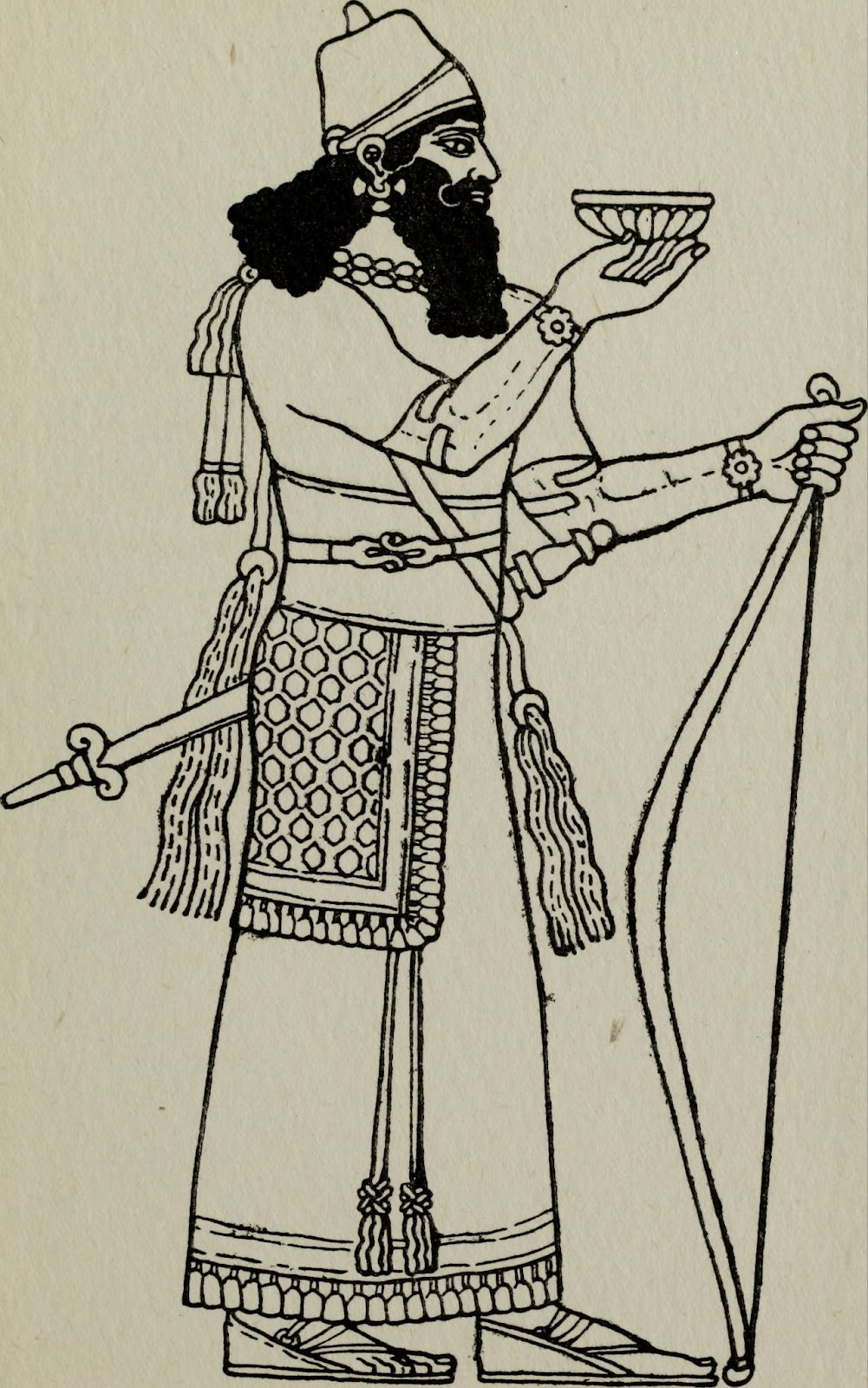
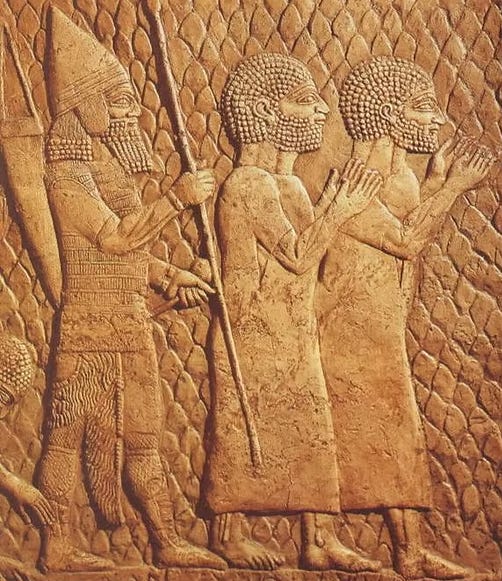
This is actually what Rabbeinu Bahya says regarding the merit of Tzitzit given to the Jewish people "Israel, the descendants of Shem who later on received the Torah were given the commandment of ציצית (Tzitzit), “fringes” on their garments as a form of distinction.”2 Furthermore, we can actually find evidence for the “descendants of Shem” wearing Tzitzit, even those outside of Abraham’s lineage. Pictured is an example of common Assyrian dress, the children of Asshur, replete with numerous tasseled garments. We also have Assyrian reliefs with more than Assyrians, but even the Jewish prisoners captured by Assyria are pictured wearing Tzitzit (at the bottom, toward their feet).
Both of these reliefs may picture figures that resemble a combination of images similar to Shem’s, who likely wore quite a familiar set of outfits with some possible additional priestly adornments. Importantly, these aesthetic fashion choices help contextualize the story within its cultural milieu. Very clearly, Shem was integrated with the bureaucratic customs of his era, but despite this role as a trendsetter in garment choice, he was unable to ‘cover the shame’ of those who misappropriated ideas about God.
What likely happened from an anthropological standpoint was Shem would have been unable to functionally teach the entire world this wisdom. Likely due to his own moral shortcomings - Shem notably lacking the same power of selfless giving Abraham was so well known for - Shem could not reliably teach, or explain the concept of God to everyone. This would have forced him to use more simple methods, such as idols, or other forms of divination and oracular powers, relative to each people's cultural contexts. In the same way the Babylonian/Sumerian elite priest-astronomer class lived at the top of their Ziggurats, rarely, if ever, coming down to the level of the lower classes, Shem would probably have spread a manipulated truth to the average people until that was all they knew about God, locking away the truth for the initiated. Even if in a very minor form, this slight flaw could have led to disastrous consequences, requiring a deep rectification.
Bereshit Rabbah 36:6
Rabbeinu Bahya Commentary on Bereshit 9:25:1