

Neo-Assyrian Empire
New Period of Assyrian Ascendancy

Lasting between 911-609 BCE, Assyria initiated what could be termed the “First Reconquista” mirroring the Spanish reconquest of lost lands, Assyria undertook centuries of warfare to regain their position. First under the Kings Adad Nirari II and Tukulti Ninurta II, the Assyrians campaigned across Mesopotamia, clashing with the nomadic Aramu. These Aramu, identical to the Arameans, were known for their guerilla tactics, which for the next 300 years would become the primary thorn in the side of Imperial Assyrian administrations, limiting their expansion. This psychopathic endeavor to fully suppress all resistance ultimately led to the Biblical Assyria we came to know, dramatically obsessed with power and war, willing to commit pure genocides and transfer large swaths of populations to destroy entire ethnic communities and nations.
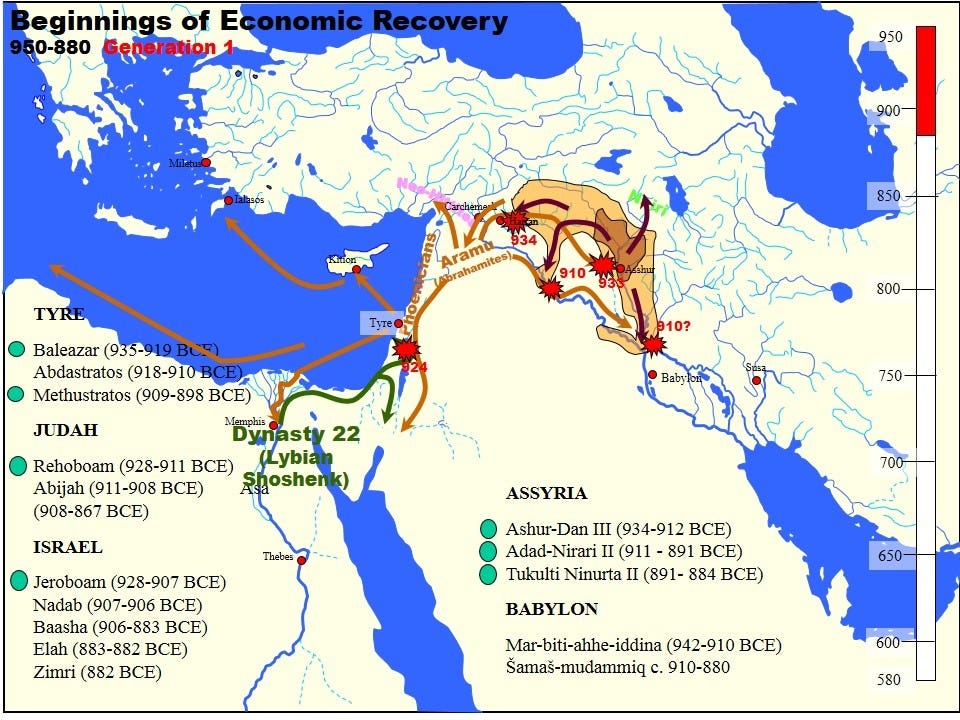
Major Non-Assyrian cities like Arrapha (Kirkuk), and Harran were extensively dominated during this period, and treaties with Babylonian King Namu Shuma-ukin I formalized their border in the south helping stabilize the position of the Assyrian monarchy. For many centuries, Arrapha became the center of Assyrian campaigns in the east, while Harran became a provincial capital of the west. Having long been the center of the moon god cult, Harran was one of the few cities, along with Ashur, exempt from paying taxes to the Assyrian Kings; a status known as Zakutu.1 This meant Harran was exempt from the Ilku - a feudal land partitioning system - as well as the Tupsikku, effectively enforced state labor. Other than Harran and the spiritual capital of Assyria itself, Ashur, only cities like Babylon and Sippar, itself an ancient religious center, were given exemption from these obligations. Effectively, these four cities all were separated out from the technical imperial administration, having been seen by the Assyrian royalty as a major threat to their rule due to the prominent religious position held by these cities among the common population.
In the following century, Harran became the seat of the nations commanding general, called the Turtanu in Assyrian, but also known as the “Tartan תַּרְתָּן” in Hebrew from the Tanakh.2 The Tartan would soon become a major threat to Assyrian Kings and their authority, often autonomously controlling their territory. Despite this threat to their authority, Harran’s incredibly ancient moon cult forced Assyrian rulers to pay deference to the cities priesthood, with kings such as Shamaneser III and Ashurbanipal contributing to renovations of the Eḫulḫul - the nearly 2000 year old “Temple of Rejoicing”.3 These connections might run deeper than they first appear; we will see in his own section how Terah, father of Abraham, actually is connected to the moon god through the etymological relation between the Hebrew term Yerach, meaning moon. When we learn from the Medieval Midrash Sefer HaYashar that Terah was a “chief” of Nimrod’s army, thus a general who led troops into battle, we can imply Terah was effectively a Tartan of Nimrod, and even in that period Harran was a common site for ambitious political rivals. Perhaps for this reason, this story continued to resonate down through the Kings period.
During this era coinciding with the Omride Kings period, rather than the biblical Patriarchs, Ashurnasirpal II attempted to relocate the capital once again to the restored ancient city of Nimrud, which most probably is either the Biblical Rehoboth-Ir, Calah or Resen - all three cities being from Genesis 10:11-12 which states “From that land emerged Asshur, and he built Nineveh and Rehoboth ir and Calah. And Resen, between Nineveh and between Calah; that is the great city”.
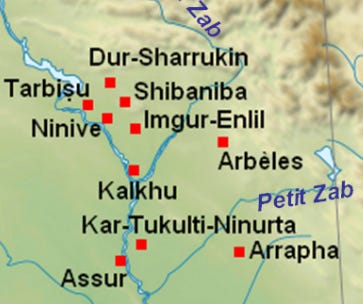
We must delve into this subject briefly, but these cities, all founded by Ashur, form the core axis of the Assyrian Empire. Ashur to Nineveh is the nexus of the “Assyrian Heartland” along the banks of the upper Tigris river. Ashur was the primary capital for centuries, while Nineveh later became the primary capital under Sennacherib in 705 BCE. Between these two cities were Rehoboth-Ir, Calah and Resen. The intermediate capital, Kar-Tukulti-Ninurta, was also located between Nineveh and Ashur, and may be identified with one of these three sites. Ashur built Nineveh, and these three aforementioned cities, regardless of the later renovations under rulers who shifted their capital north.
Which of these three cities is to be identified with “Nimrud” is unclear, but the connection to the name “Nimrod”, whose land Ashur emerged from, heavily implies that one of these three sites is to be connected with the location of Nimrud. Traditionally, the site of Kalhu should be associated with Nimrod, which was probably a later name given to the site based on ancient myths about the famed Nimrod, probably a patron of Ashur. If Nimrod was the “living man” who patronized the city of Ashur who was the defied ‘founding god’ of the city, then the man responsible for founding this city would have been Nimrod, even from the perspective of the Assyrians, but we cannot be certain. Perhaps this name was chosen by Sennacherib to call back to the “greatest known ruler of Mesopotamia”, and honor his legacy as some progenitor, or perhaps specifically patron to the building of the early Assyrian cities. Maybe the Assyrian Kings even realized the “mythological” founding status of the city under Ashur, the god, was less realistic than Nimrod granting a man named Ashur rights to found colonies in Assyria. It is impossible to speculate on these causes, and we will never have proper records of these events which at the time were seemingly minor occurrences. History, sadly, does not write itself.
However, what remains most likely to me is the idea that this “Great City” was a sort of proto-megacity that combined all three of these cities into what effectively was managed like a megalopolis. This theory stems from a brief connection between the name “Rehoboth-Ir” to imply a “district” rather than a distinct city. Everything from Nineveh to Calah was part of this “Great City”, including Resen and Rehoboth-Ir, while Ashur retained its distinct identity. The “Great City” thus became the new location for Assyrian rulers capitals, and numerous important sites in the heartland of Assyria. Whatever these three cities were located, it is very probable that this “Great City” was Nimrud, which should be identified as the Biblical Calah. Nimrod was perhaps a later name rooted in the memory of Nimrod as a patron of Ashur. This would make the territory ‘between Nineveh and between Calah (Nimrud)’ the world’s earliest example of a megalopolis, something like the ancient world’s version of an authoritarian dictatorship. While comparisons may hold in some sense, ironically, Assyria was something closer to an anarchist ‘king of the hill’ rule-by-might competition for loyalty in a post collapse society than the top-down centralized surveillance state of the Egyptian Pharaohs whose own rule evidently influenced the Assyrians style of policy.
Returning to Ashurnasirpal, it was largely during his reign that Assyria became known as a brutal, dominant empire. During a major revolt at the cities of Tela and Suru, during his first campaign in 883 BCE, Ashurnasirpal ordered the cutting off of noses, ears, fingers, limbs, gouging out eyes, and even personally overseeing impalements and decapitations. These conquests mirror the campaigns of later rulers like Genghis Khan, or the resistance against the Turks of Vlad the Impaler, from where modern vampire lore descends. In many ways, Ashurnasirpal’s reign was quite “vampiric” and bloodthirsty, using violence and fear as a means of centralizing power.
Irrespective of his brutality, Ashurnasirpal was undeniably successful being the first ruler to finally defeat the Aramean kingdom of Bit Adini under their notoriously restless king Ahuni. Ahuni had often raided across the Euphrates into Assyria, threatening the very heartland of the empire, and his acceptance of vassalization under Ashurnasirpal enabled a peace between the two regions that led to Assyria extending power all the way to the Mediterranean coast. Nearly all the Phoenician cities such as Sidon, Byblos, Tyre, and Arwad all paid tribute to Ashurnasirpal, as well as important cities such as Carchemish and Patina.
Green, Tamara M. (1992), p. 20. The City of the Moon God: Religious Traditions of Harran. Brill.
Fascinating and valuable!! Yes, fully develop this and expand your work. You are hitting all your targets.