

Ashur
The One and Only

Ashur is a curious one. We know today exactly who the Assyrians are, without dispute, everyone agrees modern Assyrians are the same people that built the great Empires of old. Many modern Assyrians will even take “blame” for their biblical past in recognition of their near genocidal conquests - a deep repentance (teshuva) is present in them, as if the warnings of Jonah have been heard. Perhaps that is why most Assyrians today are intensely Christian, in a region surrounded by Islam, retaining a link to their ancient biblical past - after all, the Quran does not include the “Bible”, and denies the biblical events that defined both the Jewish and Assyrian peoples history. It would be impossible to provide a comprehensive view of Assyria in one or two chapters, and the scope of such an endeavor is well beyond this work. While we are not attempting to cover the entire history of Assyria, or its people, we will provide contexts necessary to understand the national role of Ashur as an ancient state. Those looking for a complete look at the evolution of Assyria should turn their attention to one of the numerous archeological texts written on the subject which will be extensively cited in these chapters.
Assyrian history is divided into multiple periods in traditional archeology, but for our purposes we will split their periods into Antediluvian (correlating with the Early period), Patriarchal (correlating to the Old Assyrian period) and Kingdom (correlating with both the Middle and Neo Assyrian Empires).1 While this earliest Antediluvian period certainly shows successive settlement of the city between 2600-2100 BCE, Ashur as a city lacked an independent king.2 This situation only changed following the collapse of the 3rd Dynasty of Ur, following which Puzur-Ashur I founded the official Assyrian royal lineage. During this early Antediluvian period, Assyria was merely referred to as “ālu Aššur” (city of Ashur), which shifts in later periods to “māt Aššur” (land of Ashur) to signify the emerging regional importance of Assyrian power. This shift occurs roughly between the Old and Middle Assyrian periods around the 14th century BCE during the reign of Ashur-uballit I.3
One critical difference between these periods was the titular deity of the city “Ashur”, who was actually considered the direct ruler and king of the Assyrians in the Old period.4 Rulers before the Middle period only called themselves by the title “Išši’ak” which meant governor5, showing how they felt themselves subservient to the god of the city. This is in stark contrast to the Egyptian Pharaohs, who viewed themselves as deified, but this shift toward deification of the Assyrian rulers begins to occur as their bureaucracy expands.
These differences are critical to actually understanding the words of Genesis regarding the Assyrian founding. “And Cush begot Nimrod; he began to be a mighty man in the land. He was a mighty hunter before the Lord; therefore it is said, “Like Nimrod, a mighty hunter before the Lord.” And the beginning of his kingdom was Babylon and Erech and Accad and Calneh, in the land of Shinar. From that land emerged Asshur, and he built Nineveh and Rehoboth ir and Calah. And Resen, between Nineveh and between Calah; that is the great city.”6 Many debates have arisen over the exact reading of these words, specifically “who founded the Assyrian cities?” There is a simple answer, according to Bereshit Rabbah “Since Asshur saw his sons obeying Nimrod and rebelling against the Omnipresent by building the tower, he departed from their midst.”7 I am in complete agreement with Midrash, and thus also Rashi who cites this as a source, clearly Nimrod is not the founder of the Assyrian cities, but Asshur emerged from Shinar as a land, meaning Mesopotamia, perhaps settling more north to escape the political gravity of the south that had built the tower located somewhere near Ur. This specifically correlates well to the era of Puzur-Ashur I, and the emergence of Assyria following the collapse of the 3rd Dynasty of Ur.
Ashur did in fact build Nineveh, Rehoboth Ir, Calab, and Resen. The confusion regarding Nimrod or Ashur is almost exclusively resulting from the Assyrian founding mythology, and their own understanding of their lineage. From the vantage of the Assyrians, they were in continuity with the earlier Akkadians, who were themselves also Semitic people and viewed as their ancestors.8 The Akkadians were the Empire of Nimrod, and thus it was from “Akkad” that Ashur emerged. Even more interesting is the fact the Torah does not actually mention “Ashur” as a city. This is likely due to the blurred distinction between Ashur as a city, land, and also as a titular god of the Assyrian people. Lining up with the earlier point that Assyrian rulers actually never used the title “Sar” for King, and called themselves Governors of Assyria, you can easily presume that the “Ashur” from even the Biblical text is actually the king founder of Assyria, the ‘god’ himself who was credited with founding Assyria and its cities. This may be a rare case where the specific ‘identity’ of a Biblical figure is identified with something closer to a higher level emanation, effectively the ‘angel of Assyria’, rather than the true founder of a dynasty.
One curious naming convention of the Assyrian royalty was usage of the name “Baltil/a” in reference to the earliest region of Ashur. It is still unclear exactly what Baltil is meant in reference to, but it appears like some sort of regional settlement, potentially of Hurrian origin due to the attestation of this name in Hurrian sites at the nearby city of Nuzi.9 From a later Stele constructed by Neo-Babylonian king Nabonidus (meaning around the sack of the first Temple in Jerusalem, 550 BCE~, over two thousand years later than the period we are currently discussing) we are told that Baltila was the capital of “Subir”. Subir is another variant of the term Subartu, which was essentially the Akkadian term for the region. Interestingly, Assyrians almost never chose to use this name “Subartu” in any form, potentially due to the derogatory nature this name took on resulting from massive importation of slaves from “Subartu”, becoming effectively synonymous with ‘slave’ in much the way the term Slav functioned.10
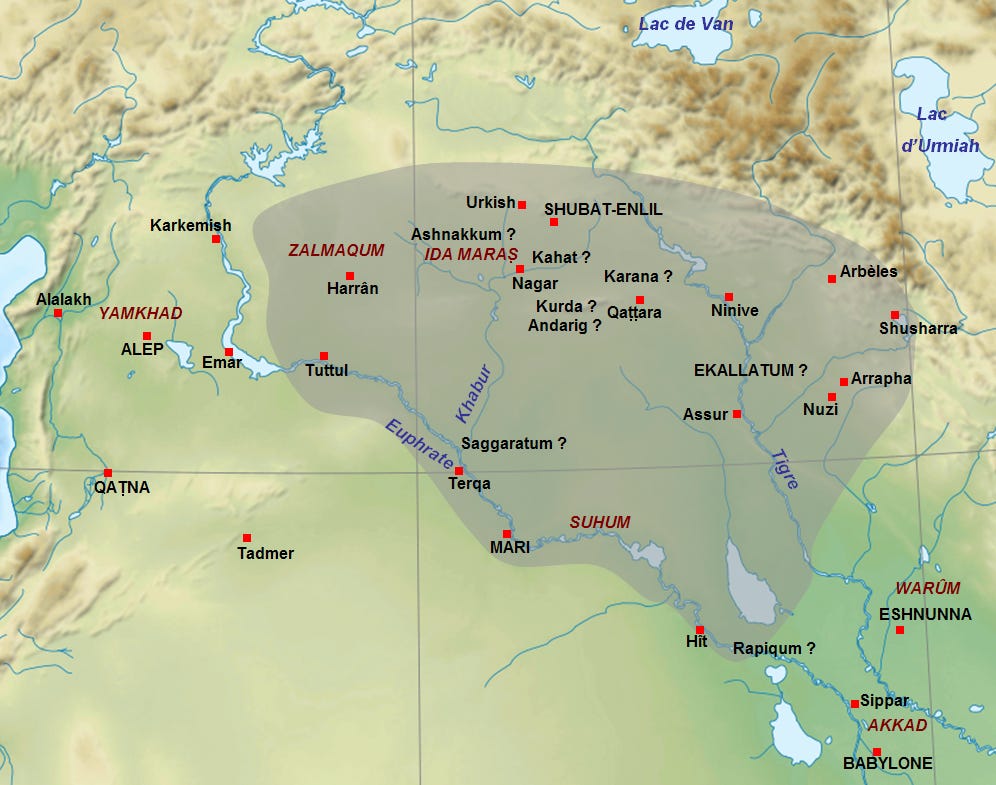
Temples from the early Assyrian period are clearly devoted to Ishtar11 and a number of fertility cult related nude female figurines - indicating some sort of fertility cult was present at Ashur.12 Interestingly, this aligns with the supposed “Hurrian” origin of the region as Batila - Ishtar was a titular deity of the Hurrians, known as the Goddess of the Night. Due to this connection, the Assyrians imported worship of Ishtar as their patron deity. We find that “Assur” as a deity is rarely directly worshipped in this period, implying a sort of personification of the city in later periods as the god Assur himself. The land of Assur essentially began to be regarded as ‘holy land’ for Assyrians in a similar way to how Jerusalem functioned for Israelites.13
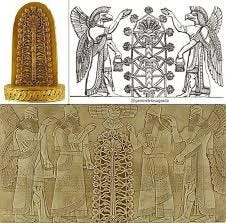
Ashur was a unique god in the ancient world given his inexplicit origin among the city’s inhabitants. Ashur was effectively a ‘god of life’, including both death, revival, and agricultural activities - an interesting correlatary to the ‘fertility’ of Ishtar.14 We see evidence of his function as both a god over life, but also agriculture in his main associated imagery such as the “Tree of Life”. Through this symbology, Ashur retained his role as a god of death, revival, and life.15
This Tree of Life is slightly different than the one readers might be familiar with in Jewish Kabbalah. That “Sefirot” Tree of Life, known as the Etz Chaim, is a later 16th century Lurianic reformulation of earlier symbology around this so-called “Tree”. The Lurianic tree is a 10 node model based around the formulae laid out in the opening line of the Sefer Yetzirah, stating “10, not 9, 10 not 11”. In this model, the tree can be numerous ‘nodes’, and represents something much closer to an archetypal imagery around ‘flowering’ and the birthing of life itself. This may be the actual “Tree of Life” from Genesis in the Garden of Eden - often forgotten as another tree in the Garden alongside the Tree of the Knowledge of Good and Evil, which is the one Adam is forbidden to eat from; while the tree of life might already have been ‘eaten’ from by humanity. Similarities between these two models are impossible to ignore, and it is perhaps the difference between “Life” and “Knowledge” that perforce the different representations of these trees in symbology. Curiously, one of the Assyrian representations has 13 flower nodes, potentially mirroring the Thirthreen Attributes of Mercy, which themselves sort of operate as a separate “tree” model within Kabbalah. Interestingly, all of this is effectively synthesized by Luria himself, who doesn’t really create a 10 nodded model of the Sefirot as is typically realized, this model was already long present in Kabbalah, Luria’s innovation was the successive descension of the model through Tzimtzum (debatably defined as either contraction, or concealment) which itself enabled a multi-nodal model known as the Partzufim to emerge. Whatever the origin of these concepts, they are clearly mystical archetypes known throughout the ancient world by Semitic peoples closely related to Abraham, himself the reported author of the first 8 lines of the Sefer Yetzirah!
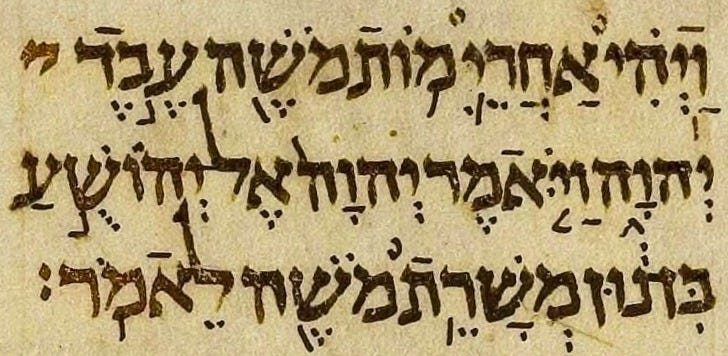
One critical link between Assyria and the Jewish people - which might actually support an extremely early origin for the Sefer Yetzirah and other mystical writings - is actually the script used to write Tanakh and Talmud. Known as Ktav Ashuri, which literally translates to “Assyrian Writing”, this square script is the traditional form one envisions when thinking of written Hebrew. Halachically, meaning legally, this is the only permitted script to write the Tanakh, but additionally Tefillin and Mezuzah share this requirement.16 This was most probably the script used to write Imperial Aramaic, the official language of both the Assyrian and Neo-Babylonian Empires, as well as extensively used in the Persian empire.
To help clarify what this script is, we should differentiate it from “Paleo-Hebrew”, also known as Ktav Ivri, which was a much earlier script used by the Israelites for less religious purposes. From Tractate Soferim 1:6 we learn “[The sacred texts] may not be written in [obsolete] Hebrew characters, or in the Aramaic, Median or Greek languages. If they were written in any other language or in any other characters they may not be used for the lection [in the statutory services], since they must be written in the Assyrian [script].” These “obsolete Hebrew characters” are in reference to the Paleo-Hebrew scripts previously used to write Torah scrolls, before the edicts of Ezra who is reportedly the one who enforced all sacred texts being written in Ktav Ashuri. However, a lengthy debate across the Talmud disputes the exact “switching” of the script by Ezra, with most sages agreeing that Ezra probably was not switching from Ivri to Ashuri, but rather he was switching back to Ashuri, which had been changed to Ivri incorrectly.17 This “Ktav Ivri, Hebrew Script” is still in use today, notably by the Samaritans who dispute Jerusalem as the central capital of Israel - quite an absurd conjecture.
Frahm, Eckart, ed. (2017)a, p. 5. A Companion to Assyria. Hoboken: John Wiley & Sons.
Roux, Georges (1992), p. 187.. Ancient Iraq. Penguin Books.
Aissaoui, Alex (2018). “The Amarna diplomacy in IR perspective:a system of states in the making”. Estudos Internacionais. 6 (2): 9–29.
Lewy, Hildegard (1971), p. 754. “Assyria c. 2600–1816 BC”. In Edwards, I. E. S.; Gadd, C. J.; Hammond, N. G. L. (eds.). The Cambridge Ancient History: Volume I Part 2: Early History of the Middle East (3rd ed.). Cambridge: Cambridge University Press.
Radner, Karen (2015), p. 3. Ancient Assyria: A Very Short Introduction. Oxford University Press.
Genesis 10:8-12
Bereshit Rabbah 37:4
Lewy, Hildegard 1971, p. 735. “Assyria c. 2600–1816 BC”. In Edwards, I. E. S.; Gadd, C. J.; Hammond, N. G. L. (eds.). The Cambridge Ancient History: Volume I Part 2: Early History of the Middle East (3rd ed.). Cambridge: Cambridge University Press.
Lewy, Hildegard 1971, p. 731. “Assyria c. 2600–1816 BC”. In Edwards, I. E. S.; Gadd, C. J.; Hammond, N. G. L. (eds.). The Cambridge Ancient History: Volume I Part 2: Early History of the Middle East (3rd ed.). Cambridge: Cambridge University Press.
Lewy, Hildegard 1971, p. 732-733. “Assyria c. 2600–1816 BC”. In Edwards, I. E. S.; Gadd, C. J.; Hammond, N. G. L. (eds.). The Cambridge Ancient History: Volume I Part 2: Early History of the Middle East (3rd ed.). Cambridge: Cambridge University Press.
Veenhof, Klaas R.; Eidem, Jesper 2008, p. 19. Mesopotamia: The Old Assyrian Period. Orbis Biblicus et Orientalis. Göttingen: Academic Press Fribourg.
Mallowan, Max E. L. 1971, p. 300.. “The Early Dynastic Period in Mesopotamia”. In Edwards, I. E. S.; Gadd, C. J.; Hammond, N. G. L. (eds.). The Cambridge Ancient History: Volume I Part 2: Early History of the Middle East (3rd ed.). Cambridge: Cambridge University Press.
Lambert, W. G. (1983). “The God Aššur”. Iraq. 45 (1): 82–86.
Breasted, James Henry 1926, p. 164. The Conquest of Civilization. New York: Harper & Brothers Publishers.
James, E. O. (2018) 1966, p. 42. The Tree of Life: An Archaeological Study. Leiden: BRILL.
Babylonian Talmud (Megillah 2b; Shabbat 104a; Zevahim 62a; Sanhedrin 22a), Jerusalem Talmud (Megillah 10a)