

Arkites
“And the Arkites” (Genesis 10:17)

Bereshit Rabbah 37:6 gives us an explicit identification “and the Arkites” – Arka of Lebanon”. Modern Arqa is merely a Lebanese village situated inside the fertile Akkar plain not far from Tripoli.1 The Akkar plain is also the site of Tell Kazel, which we will identify later with the important city of Sumur that demarcated the boundary between southern, and northern Phoenicia. In Egyptian and ancient sources the city was probably known as Irqata, and engaged in communication with the Pharaoh’s in the Amarna letters.
The Amarna letters offer the best clue into the ancient political situation of the Arkites, during their conflict for control of the region. During the invasions of the famous Habiru - almost certainly the identification of ‘Hebrews’, but containing additional semitic elements like Lot and the Arameans - the King of Byblos (Gubla, from Gebal, the word for mountain) named Rib-Hadda sent over 68 letters to the Pharaoh Akhenaten imploring him for assistance against these attacks. Akhenaten, being probably more spiritually related to the monotheistic Habiru than the fully pagan Rib-Hadda, eventually sent back a letter saying “Why do you alone keep writing to me?”2 Basically, he told him “you’re annoying and I don’t like you, and good luck”; Akhenaten, always the funny guy.
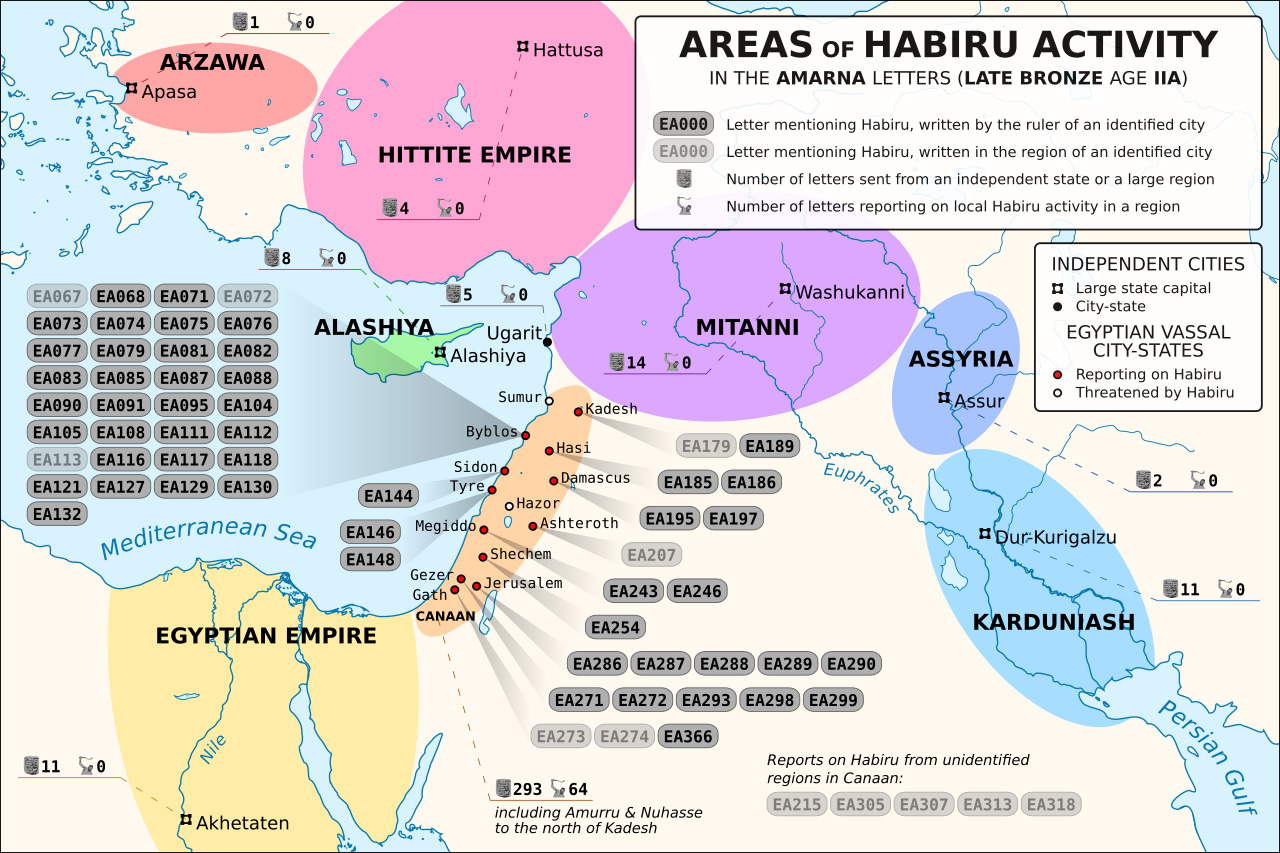
This story is important though because the other two states holding out against the Habiru were Sumur (Zemarites) and Irqata (Arkites). Irqata writes a lengthy clay-tablet letter titled “The city of Irqata to the king” where they simply ask for more troops, and military support.3 It closely affiliates two of the children within Canaan as not just geographic neighbors, but actually allied culturally, viewing one another as brothers. This was probably the case for most of the Canaanites writing in the Amarna letters during the progressive invasions of the region throughout the course of the Bronze Age, and clearly felt a distinct identity from the incoming Semitic waves.
There is actually a biblical figure identified as an ethnic Archite, the friend and loyal spy of David, Hushai. “And David was coming to the top where he would prostrate himself to God, and behold, towards him [came] Hushai the Archite with his shirt torn, and earth upon his head.” The only problem here is that the term Archite actually uses an Aleph, rather than an Ayin like in the nation. This would imply they are different people groups, which makes sense when we look at Hushai’s native birthplace of Archi. Archi is said to be on the boundary of Ephraim and Benjamin in Joshua 16:2 “And it went out from Beth-el to Luz, and passed along to the border of Archi to 'Ataroth”.
Now, obviously, the spelling of the town and people could easily shift since a written language is meaningless to the pronunciation of a name. It is very possible both “Archi” and “Arka” were founded by the same Canaanite people group. It really is impossible to say what ethnicity Hushai was, and even if we could that doesn’t imply the original inhabitants shared his origin. For example, the city “Beth-el to Luz” was actually originally called Luz and was the same location that in Genesis 35 is renamed to Beth-el corresponding to Jacob changing his name to Israel. This effect could have taken place at any time with Archi, or Arka, making it challenging to divulge an origin on linguistics alone.
One reason I’d personally separate the two terms is actually because they do appear to have entirely different roots. Arki with an Ayin means something like ‘gnawing’ - known from Job 30:17 where it says “By night my bones feel gnawed;”, while Archi with an Aleph means “chief, officer” having a clearly distinct definition from one another. Rather than say “the terms mean different things” we can actually know the term Archi meant as officer isn’t even found merely in Hebrew.
In Greek, the famous term “Archon” - also spelled with the Greek Alpha - means ‘ruler’ or ‘chief’ in the same way Archi probably meant an officer in the government. Most readers actually use this term in English, without realizing it, every time they say mon-arch, hier-arch-y, an-arch-ism, or olig-arch-y. The term in its Aleph, and derivative forms, are all related to government positions and roles. The addition of the title “Kings Friend” for Hushai implies a specific administrative role as one of the Kings ‘Archons’. Hushai was effectively an archon - not from a region known as Arka - but probably mirroring ancient Greece the title had many roles from chief magistrate, head of the armed forces, and being responsible for civic religious arrangements.
Effectively, the Arkites might have been a people of Canaan inhabiting various places, and cities, but their principal location was Arka in Lebanon. They clearly played a critical role in the Canaanite cultural shifts at the end of the Bronze Age Collapse, and the city's importance all the way through the Roman era as even the birthplace of Emperor Severus Alexander, cousin of Eglabulus. The Romans giving it the distinguished title of Arca Caesarea, as well as the later strategic Crusader castle on the site, places it as a vital location necessitating its inclusion on the Table due to its role in the politics synonymous with the Israelite conquests.
"Municipal and ikhtiyariah elections in Northern Lebanon" (PDF). The Monthly. March 2010. p. 22.
EA 117 Moran, p.193
EA 100