

Amorites
“And the Emorites” (Genesis 10:16)

Quite clearly, the Amorites are the Amorites, known in Sumerian as MAR.TU, and in Akkadian as the Amurrum.1 In Hebrew, the term means something like ‘a sayer’, but it doesn’t appear to be very relevant to their ethnicity. We are given a physical description of them in Amos 2:9 saying “And I destroyed the Amorites from before them, whose height is as the height of the cedar trees, and they are as strong as oaks”. They first appear around 2500 BCE, far back in the historical records, and expanded between 2100-1700 BCE to dominate much of the Levant, and Mesopotamia.
City states like Mari, Ebla, Yamhad, Qatna, Ugarit, Isin, Larsa, and even Babylon were all Amorite nations. Even the 14th dynasty of Egypt were Amorite, setting the stage for the Semitic Hyksos, showing that by the 1700s BCE nearly the entire ancient world's superpowers were Amorites in some form. The most important famous Amorite is actually Hammurabi placing these Amorites as possibly the most important ancient group in developing civilizations connected inter-regional trade networks.
Akkadian people, viewing themselves at the center, considered ‘Martu’ as one of the “Four Quarters surrounding Akkad” along with Sumer (south), Subartu (north), Elam (east) and thus obviously making Martu (west).2 The entire Levant was essentially the region of Martu, but probably much of the upper Euphrates region also slotted into this identity sharing ethnic connections to the Levant. At the turn of the 15th century BCE we see this term shift into its more well known form ‘Amurru’ where it is usually applied to the region between Canaan and the Orontes river in Syria.3
After the rise of the Hittites and Assyria, the dominance of the Amorites begins to crumble and an influx of nomadic West Semitic speaking groups known as Ahlamu displace the Amorites. Most of this happens during the Bronze Age Collapse, making the Amorites another victim of this international order shifting event. Amongst these “Ahlamu” groups were the Arameans, who seemingly assimilated large swaths of the Amorite people into their culture making them somewhat of a successor group after 1200 BCE.
The fact they speak a West Semitic language is pretty important to this picture, and helps us piece together their ethnic group. Semitic languages fall into two major categories: West and East. Eastern languages include the important Akkadian that went extinct with the fall of the Akkadian empire, but also the dialects of most Semitic speakers that lived inside Mesopotamia such as Ebla, Mari and Kish. All of these languages have died out.
West Semitic on the other hand is thriving, divided again into two broad branches: Central and South. Southern languages composed the broad Ethiopian groups, notable for Ge’ez, Amharic, and Tigrinya; as well as the Yemenite languages such as Sabaean, Qahtanite, Hadhramautic, and the still extant Mahri groupings in the south of Oman’s Dhofar region, and Socotra.
Central is the real nightmare, but can also split off Arabic as its own macro family within the central Semitic grouping, although sharing a massive glossary with the other branches. Canaanite, and its close brother Aramaic, comprise the vast majority of the Levantine groups after the BAC, with Hebrews, Phoenicians, Moabites, Edomites, Ammonites all speaking essentially the same mutually intelligible language. Aramaic, as well as Nabatean, are to this day pretty mutually intelligible with Hebrew showing the relationship between all these Central Semitic groups, and their shared origins.
Amorite, and its cousin Ugarit, are actually the ancestors of both Arabic, Hebrew, and Aramaic (and their cousins/brothers), and most of these groups remixed the Amorite languages for their own usage. Various diverse mixes of nomadic, Semitic speaking groups such as the Shutu, Ahlamu, Shasu, and ‘Apiru all probably assimilated into their various geographic regionalities to form distinct people groups from the original inputs. The map does a better job at explaining this than I can in words.
What seems obvious is the widespread Amorite ethnicity around the ancient near east, and their eventual integration into the ethnic identities of many fledgling polities at the end of the Bronze Age. The early Amorite groups served as a baseline for how later Semitic groups would form their own informal alliance of city-states, led by kings speaking a similar language descendant from those legendary kings. In effect, the war between leaders such as Amraphel - and the other Mespotamian, likely Amorite kings - and the patriarch Avraham, shows the emerging conflict between these two diverse Semite groups. Avraham represented the coalition of Hebrews, or Habiru, while Amraphel and Arioch were Amorite leaders failing to maintain control over an emerging subclass within Canaan.

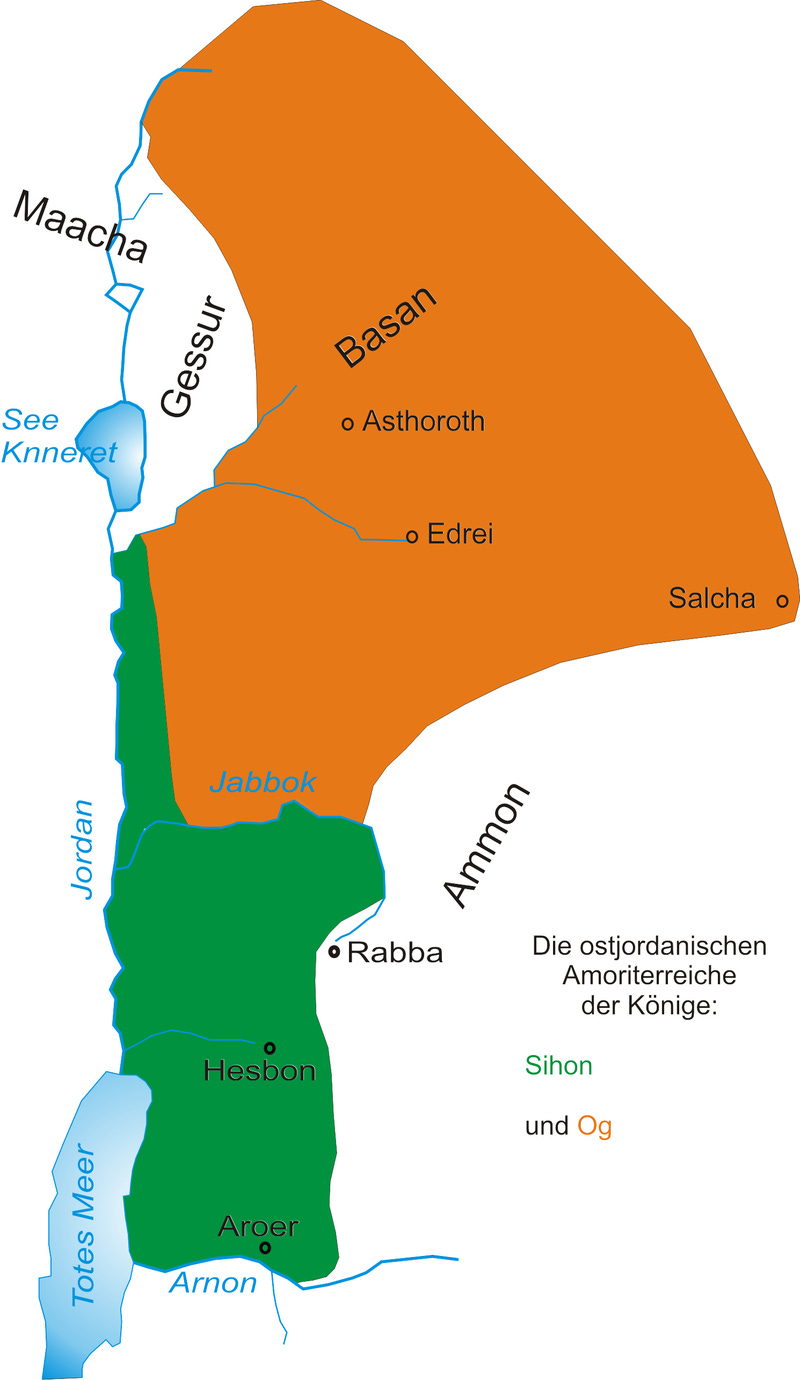
The Torah actually names a well known Amorite, the giant Sihon who was brothers with Og, King of Bashan. As covered in our Book of Nimrod, Sihon controlled a territory called Gilead that eventually fell into Israelite hands, but is initially given to Abraham’s nephew Lot’s lineage rather than the Hebrews. The major center of economic power in Sihon’s country was Heshbon which tended to swap hands between both of Lot’s children, Moab and Ammon, throughout later periods of history. Similar to how the Amorites in foreign lands ruled over diverse people groups, it’s likely that both Bashan and Gilead were not entirely Amorite, with various other Canaanite groups thrown into the mix. Critically, we see the Amorite polities of Sihon’s Gilead and Og’s Bashan as failed Amorite states unable to stave off the rise of not even the Israelites, but their nephew’s, and Lot’s children, Moab and Ammon.
The Torah effectively calls Canaan “the land of the Amorites” due to their political dominance of the land in Amos 2:10 “And I brought you up from the land of Egypt, and I led you in the desert for forty years, to inherit the land of the Amorites.” Amorites are clearly one of the primary groups the Torah claims the Israelites will dispossess of the land, which squares away with their historical waning at the turn of the 13th century, and the oncoming waves of nomadic Habiru/Shasu that displaced their control of Canaan.
In a very helpful story from Joshua we are told about an alliance of five amorite kings that declare war upon the city of Gibeon for its betrayal and signing of a separate peace treaty with Israel. “And the five kings of the Amorites, the king of Jerusalem, the king of Hebron, the king of Jarmuth, the king of Lachish, the king of Eglon, gathered together and went up, they and all their camps, and encamped on Gibeon, and made war against it.”4 This line confirms that the Amorites had an informal alliance of city-states, related by royal lineages across the Levant and Mesopotamia, enabling them to form advanced political states rivaling many of the major powers, and the fledgling Israelite nation.
The actual ethnic component of these kings is quite confusing, and later on during Joshua’s conquests he slays more Amorites, but not from the city of Gibeon. Gibeon was Amorite, in part, but is far from the only Amorite city. In fact, Gibeon's residents appear to have a Hivite component based on Joshua 9:7 where it says “And each of the men of Israel said to the Hivites: "Perhaps you dwell in my midst, and how can I make a covenant with you?”
Later in the chapter in Joshua 9:27 we are told of an agreement between Joshua and the Gibeonites “And Joshua made them that day hewers of wood and drawers of water for the congregation, and for the altar of the Lord, to this day, in the place which He would choose.” We learn they are to be hewers of wood and drawers of water in service of the Temple, enshrining their role perpetually. It was not all war between these two groups as in I Samuel 7:14 we are told explicitly “and there was peace between Israel and the Amorites.” Clearly, the Amorites stick around in some form even if their independence is greatly subsumed into the identity of the Israelites, as per the effect seen in groups such as the Gibeonites.
However, we know they are Amorite from II Samuel 21:2 where it says “And the king called the Gibeonites and said to them-now the Gibeonites were not of the children of Israel, but of the remnant of the Amorites”. This chapter is very important because it lays out the terms of agreement between David and the Gibeonites, who go on to comprise a unique ethnic element of the Israelites. The impetus for this, according to God “(It is) for Saul, and (also) for his bloody house, because he put to death the Gibeonites......and the children of Israel had sworn to them; but Saul (nevertheless) sought to slay them in his zeal for the sake of the children of Israel and Judah.”5
From the Talmud we learn of a class of people called Nethinim that are stated to be the Gibeonites. There are various special rules associated with these people, similar to the illegitimate children known as mamzers, but provides context for an actual assimilation of these people into the Israelite nation even if wrought with challenges. “Mamzerim and the Gibeonites who converted to Judaism in the days of Joshua are prohibited from entering into the congregation and marrying a woman who was born Jewish. Their prohibition is eternal, for all generations, and it applies to both males and females.”6 The Gemara specifically implies that as a result of David’s decree, the Gibeonites and the class known as Nethinim may not enter into congregation with Israel, even though they had converted to the Jewish faith.
However, in a stunning redaction of David’s decree, Yehuda HaNasi, the towering giant of Torah and the man who edited the Mishnah itself, attempts to bring these Gibeonites into the fold of Israel saying “It is related that in the days of Rabbi Yehuda HaNasi the Sages sought to permit the Gibeonites and treat them like Jews in all regards, thereby allowing them to enter into the congregation.”7 Other sages immediately disagreed with Yehuda HaNasi, putting the stop on this integration, but it is interesting that they were likely viewed as “religious Jews” from the perspective of the Tannaim.
Whatever the case, it is obvious Amorites seemed to comprise a diverse group of Canaanites, as well as non-Canaanite Amorites, that form political classes which dominate much of the Levant. These Amorites are later subsumed into the identity of many Semites, even if they originally had Hamite origins as the children of Canaan - similar to the Jebusites that Solomon allows to dwell in the Israelite midst. While the Israelites made a covenant with the Lord, these other nations' covenants with Israel appear similarly valid even with legal effects when the Temple is rebuilt during the future messianic era.
Frankfort, H. (1939). Cylinder seals: a Documentary Essay on the Art and Religion of the Ancient Near East. MacMillan and Co., Pl. XXVIII e+i
Streck, Michael P., Das amurritische Onomastikon der altbabylonischen Zeit. Band 1: Die Amurriter, die onomastische Forschung, Orthographie und Phonologie, Nominalmorphologie, Ugarit-Verlag, 2000, p. 26
Lawson Younger, K., "The Late Bronze Age / Iron Age Transition and the Origins of the Arameans", Ugarit at Seventy-Five, edited by K. Lawson Younger Jr., University Park, USA: Penn State University Press, pp. 131-174, 2007
Joshua 10:5
II Samuel 21:1-2
Talmud Yevamot 78b:5
Talmud Yevamot 79b:1
Extremely interesting for a multitude of reasons. Great work.